
Last reviewed and updated: 2026-09-24
The 30067 ZIP code covers southern Marietta toward Powers Ferry, Delk Road and the I-75 corridor. Its housing is a denser mix including substantial townhome, condominium and apartment stock, and that shapes what leaks turn up: the pipe material, the foundation type and the age of the system determine the failure pattern far more than anything else. 30067 is served by Cobb County Water System, including shared-meter communities where the association is the account holder.
Leak detection in 30067 at a glance
- Area covered: southern Marietta toward Powers Ferry, Delk Road and the I-75 corridor
- Housing era: a denser mix including substantial townhome, condominium and apartment stock
- Water utility: 30067 is served by Cobb County Water System, including shared-meter communities where the association is the account holder.
- First step either way: the water meter test. It is free and it confirms whether a leak exists at all
- Before any repair closes: get written documentation, because your utility requires proof of repair for a leak credit
Housing in 30067 and what it means
Marietta 30067 is a denser mix including substantial townhome, condominium and apartment stock. That matters because pipe material tracks build date closely: homes built between roughly 1978 and 1995 across Georgia were commonly plumbed with polybutylene, those built from the 1960s to the 1980s often have copper run under slabs, and anything older than that may still carry galvanized steel supply and cast iron drains.
The leak profile here
The leaks most often found in this ZIP code:
- Inter-unit leaks in stacked townhome and condominium buildings
- Community water loss on shared-meter properties
- Groundwater versus plumbing questions in lower-lying sections near the Chattahoochee
- Polybutylene and slab leaks in the single-family stock
| Most common leak type | Why, in this area |
|---|---|
| Inter-unit leaks in stacked townhome and condominium buildings | Inter-unit leaks in stacked townhome and condominium buildings |
| Community water loss on shared-meter properties | Community water loss on shared-meter properties |
| Groundwater versus plumbing questions in lower-lying sections near the Chattahoochee | Groundwater versus plumbing questions in lower-lying sections near the Chattahoochee |
| Polybutylene and slab leaks in the single-family stock | Polybutylene and slab leaks in the single-family stock |
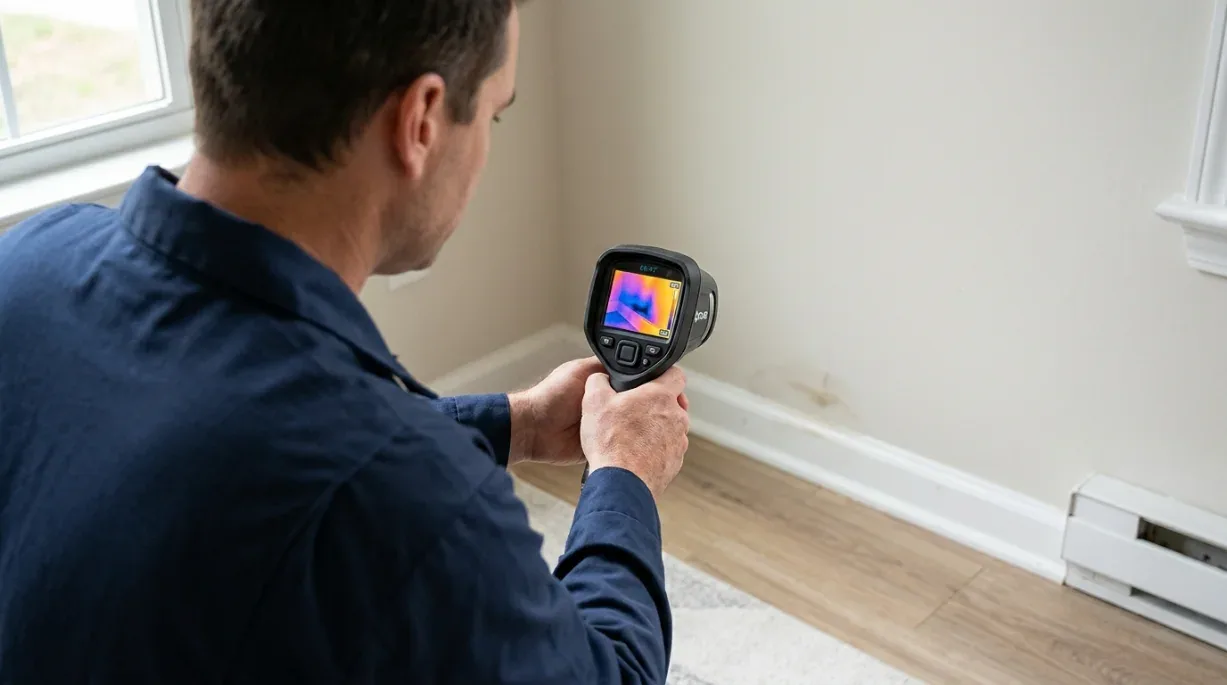
Reading the pipe before anyone opens anything
The single most useful fact about a house, before any equipment comes out of the van, is what its supply pipe is made of. It predicts how the leak will behave, where it will fail and whether a repair is worth doing at all.
The water heater is where to look, because the supply lines are exposed there. Gray flexible plastic, often stamped PB2110, is polybutylene. Dull orange rigid metal is copper. Dull gray threaded metal is galvanized steel, and if a house still has it, low pressure is usually the first symptom rather than a visible leak.
That one observation changes the plan. A copper pinhole is a spot repair. A polybutylene fitting failure is the start of a conversation about the whole system.
The twenty-minute test to run before calling anyone
Before any of this matters, it is worth establishing that a leak exists at all, and that is free.
Turn off every tap, appliance, icemaker and irrigation zone. Find the meter, usually in a covered box near the curb, and watch the low-flow indicator, the small triangle or dial that turns when even a trickle is moving. Any movement with everything off means water is escaping.
Then close the main house shut-off and look again. Still turning means the leak is between the meter and that valve. Stopped means it is inside or under the house. That single answer halves the search before anyone is paid anything. The full meter test has the detail.
Additions, remodels and the joints between eras
Plumbing in an older house is rarely one system. It is the original pipe, plus whatever a 1980s bathroom addition used, plus a partial repipe someone did after a failure, plus the drain lines underneath all of it.
Every junction between two eras is a potential failure point, and the joint between dissimilar metals is worse than either metal alone: copper connected directly to galvanized steel corrodes at the connection far faster than the pipe on either side.
It is also why a leak in a house like this is often not where the age of the house suggests. The newest pipe, badly joined to the oldest, fails first. Concealed leaks like these are mapped rather than guessed at.
Which water utility bills you here
30067 is served by Cobb County Water System, including shared-meter communities where the association is the account holder. The distinction matters: Cobb County Water System allows a partial leak credit once per rolling 12-month period across no more than two affected months, with proof of repair required, while Marietta Power & Water runs its own separate process. Check the utility name printed on your bill before applying for anything.
Before you call anyone
Southern marietta toward powers ferry, delk road and the i-75 corridor is inside our regular working area, and the corridor is covered on the same day as the rest of Marietta. If you are not sure which ZIP code your property falls in, give us the street address instead: see the Marietta ZIP code guide for how the fourteen codes actually break down.
Frequently asked questions
Do you cover the 30067 ZIP code?
Yes. Marietta 30067 covers southern Marietta toward Powers Ferry, Delk Road and the I-75 corridor, and it is within our regular Marietta and Cobb County service area.
What leaks are most common in 30067?
Inter-unit leaks in stacked townhome and condominium buildings, followed by community water loss on shared-meter properties. Housing era and foundation type determine the pattern more than anything else.
Which water utility serves 30067?
30067 is served by Cobb County Water System, including shared-meter communities where the association is the account holder. Confirm by checking the utility name printed on your bill, because the city and county run entirely separate leak credit processes.
Does it matter how old the house is?
More than almost anything else. Build date predicts pipe material, and pipe material predicts the failure mode: polybutylene fails at fittings without warning, copper under a slab fails as a slow pinhole, galvanized steel closes up from the inside before it perforates.
Can you tell me anything useful over the phone?
Often, yes. The meter reading, whether it still turns with the main valve closed, what you are seeing or hearing, and roughly when the house was built between them narrow the problem a long way before anyone arrives.