
Last reviewed and updated: 2026-09-24
A leak detection report is the written record of what was found and how, the leak type, its location, the methods used to confirm it, the probable cause and the date. It is the document an insurance adjuster works from, and it is also what supports a Cobb County or Marietta Power & Water leak credit application, since Cobb accepts "at a minimum a letter explaining what was done to correct the problem." Ask for it before the job is closed out.
One document does two jobs: it evidences cause and location for an insurance claim, and it satisfies the proof of repair a Cobb County or Marietta Power & Water credit requires.
What a useful report contains
- Property and date. Service address, date of inspection, date of any repair.
- The complaint. What the homeowner reported, running water sound, high bill, damp flooring.
- Confirmation. That a leak was verified, and how, meter test, pressure test result, which lines held and which lost.
- Location. Where the leak was pinpointed, described clearly enough for someone who was not there.
- Methods used. Acoustic listening, line tracing, thermal imaging, tracer gas, camera inspection, and which one confirmed it.
- Probable cause. Corrosion, fitting failure, material failure, root intrusion, physical damage. This is the line that matters most for an insurance claim.
- Sudden or gradual. An honest assessment, because it speaks directly to the wear-and-tear exclusion.
- Photographs. The location marked, the opened area, the failed pipe, the completed repair.
- What was repaired. Parts replaced, work performed, completion date.
- Identification. Company name, contact details and Georgia license number.
One document, two different jobs
| Insurance claim | Utility leak credit | |
|---|---|---|
| What it must prove | That the failure was sudden and accidental, and what damage resulted | That a genuine leak existed and was corrected |
| Most important section | Probable cause, and sudden vs gradual | What was repaired, and when |
| Who reads it | Claims adjuster | Utility billing department |
| Minimum acceptable | Detailed technical report with photographs | Cobb accepts a repair receipt, a parts receipt, or a letter explaining what was done |
| Timing | Before demolition and reconstruction | Before you submit the credit application |
The most common and most expensive mistake: repairing the leak first and asking for documentation afterwards. Once the slab is closed, the wall is patched and the trench is backfilled, the evidence is gone. Request the report while the work is still open.
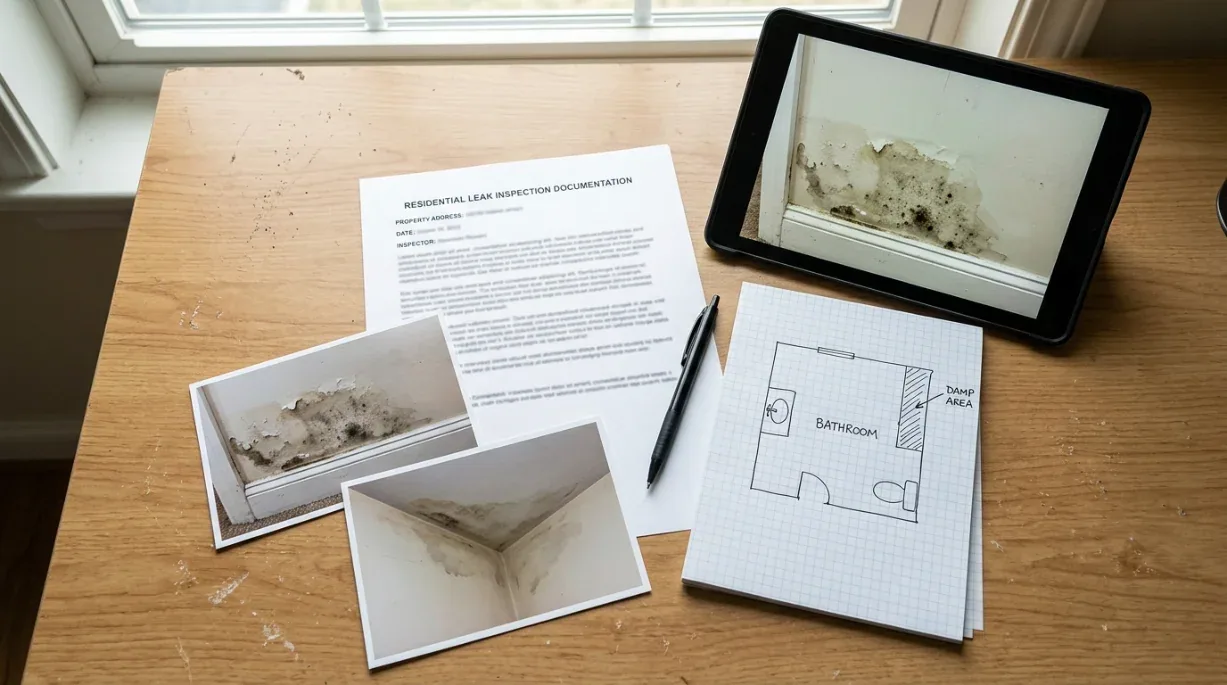
Ask for these before the job closes
- Written report on company letterhead with the Georgia license number shown.
- Photographs at every stage: before opening, the failed pipe exposed, the completed repair.
- A clear statement of probable cause in plain language.
- The itemised repair invoice, separate from the detection documentation.
- Digital copies emailed to you, not just a paper slip.
Frequently asked questions
What is a leak detection report?
A written record of the inspection: the reported symptoms, confirmation that a leak exists, its pinpointed location, the methods used to confirm it, the probable cause, photographs, and what was repaired. It is the technical evidence behind both an insurance claim and a water utility leak credit application.
Do I need a report for a Cobb County leak adjustment?
Cobb County accepts a plumbing repair receipt, a receipt for parts, or at minimum a letter explaining what was done to correct the problem. A written report satisfies that requirement comfortably and leaves less room for the application to be questioned.
What makes a report strong for an insurance claim?
A clear statement of probable cause and an honest assessment of whether the failure was sudden or gradual, supported by photographs. Those two points speak directly to the exclusions adjusters apply most often: wear and tear and gradual deterioration.
When should I ask for it?
Before the job is closed out. Once the slab is repoured, the wall is patched and the trench is backfilled, the evidence no longer exists and the documentation becomes much harder to produce.
Can the same report be used for both the insurance claim and the water bill credit?
Yes, and it usually is. The insurer focuses on cause and damage; the utility focuses on proof that a real leak existed and was corrected. A thorough report covers both.
What if the leak was repaired before I thought about documentation?
Ask whoever did the work to write a letter describing what the leak was, where it was, how it was found, what was repaired and the completion date, on their letterhead. Combined with any photographs and the invoice, that is normally enough for a utility credit application, though it is weaker evidence for an insurance claim.