
Last reviewed and updated: 2026-09-28
Pinhole leaks in Cobb County copper pipe are not caused by aggressive water. The Cobb County-Marietta Water Authority reports a pH of 7.9 and average hardness of just 38 mg/L, which is soft, non-acidic water. Its 2012 engineering study attributed pinholes to excessive solder flux left by poor soldering at installation, and it reports that they cluster where chlorine residual is low or household water use is low.
What is actually in Cobb County's water
The Cobb County-Marietta Water Authority treats and supplies the water that Cobb County Water System delivers. It publishes the figures that matter for pipe corrosion:
| Measure | Cobb County water | Why it matters for copper |
|---|---|---|
| pH | typically 7.9 | Non-acidic. Acidic water below about 6.5 attacks copper; this does not |
| Hardness | around 38 mg/L as CaCO₃ | Soft water. Very little scale forms inside the pipe |
| Disinfectant | sodium hypochlorite | Chloramines are not used, so the chloramine-corrosion theory does not apply here |
| Corrosion control | lime added to raise alkalinity | A deliberate treatment step to protect plumbing |
That combination rules out the explanation most plumbing articles reach for. Cobb's water is not eating the pipe.
The 2012 finding: it was the installation, not the water
A 2012 study by HDR Engineering, commissioned to investigate pinhole leaks in the system, identified the cause as excessive solder flux, left behind by poor soldering practices by the installing plumbing contractor.
Flux is the acidic paste applied to clean the joint before soldering. If too much is used, or the line is not flushed properly afterwards, the residue sits inside the pipe and corrodes it from the inside out, downstream of the joint. That is why pinholes in these homes often appear in clusters on the same run, and why two identical houses on the same street can have completely different histories: they had different plumbers.
Why low water use makes it worse
The authority reports that pinholes occur in parts of the distribution system with relatively low chlorine residuals, or in homes with relatively low water use.
That second point is the practical one, and it explains a pattern we see across Marietta:
- A guest bathroom nobody uses for months
- A basement wet bar or a second kitchen that sits idle
- A rental between tenants, or a house on the market and empty
- A second home, or a property where the owners travel for long stretches
Water sitting still in a copper branch line behaves differently from water that moves. If you have a fixture nobody touches, running it for a minute every week or two costs nothing and keeps the line turning over.
A 2018 theory that did not hold up locally. A Virginia Tech study hypothesized that low chlorine residual areas might see more sulfate-reducing bacteria, which could drive pinholes. CCMWA's own 2018 testing of homes with documented leaks found no such bacteria present. It is worth knowing, because the theory still circulates.
Rather talk it through first?
No forms and no waiting for a callback. Speak to a technician, describe what you are seeing, and get a straight answer about what it takes to find it.
What a pinhole leak looks like before it is obvious
A pinhole is small. It does not flood a room, which is exactly why it runs for months.
| What you notice | What it usually means |
|---|---|
| Green or white crust on a copper pipe in the basement | An active pinhole weeping and evaporating |
| A stain on a ceiling below a bathroom | Water traveling along a joist from a pinhole upstream |
| A bill that has crept up over several months | Something running continuously and out of sight |
| A musty smell in one room only | Long-running moisture in a wall or under flooring |
| A second leak within a year of the first | The material or the workmanship, not bad luck |
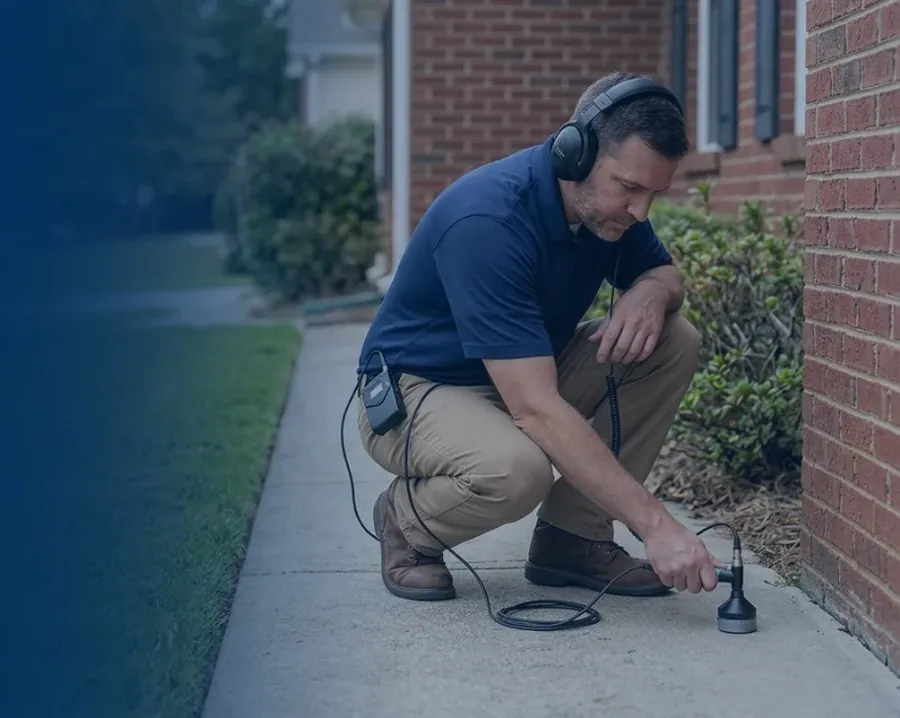
Because copper pinholes are quiet and slow, they are usually found with thermal imaging and moisture mapping rather than by listening. Where the pipe runs under concrete it is a slab leak and is located acoustically instead.
One pinhole or a repipe?
This is the decision that actually costs money, and the flux finding changes how to think about it. If the cause was workmanship on one run, a spot repair is reasonable. If the same system has failed more than once, the odds are the whole installation shares the same problem.
A second pinhole in the same house within a year or two is the signal. At that point repairing individual points becomes a recurring expense, and the arithmetic shifts toward a partial or full repipe. The repair options page sets out what each route involves.
Where these figures come from
Everything above is taken from a published source. Rates, policies and conditions change, so check the date on each before relying on it.
- Cobb County-Marietta Water Authority, Pinhole Leaks: pH 7.9, hardness ~38 mg/L, sodium hypochlorite disinfection, lime for corrosion control.
- HDR Engineering study, 2012, cited by CCMWA: excessive solder flux from installation practice.
- Virginia Tech study, 2018, cited by CCMWA, together with CCMWA's own 2018 testing that found no sulfate-reducing bacteria in affected homes.
Frequently asked questions
Is Cobb County water hard or soft?
Soft. The Cobb County-Marietta Water Authority reports average hardness of around 38 mg/L as calcium carbonate, with a pH of about 7.9. Soft, non-acidic water forms very little protective scale inside copper pipe, but it is not itself corrosive.
Does Cobb County use chloramine in the water?
No. CCMWA uses sodium hypochlorite for disinfection, not chloramines. This matters because the chloramine-corrosion explanation that appears in a lot of plumbing content does not apply to Cobb County homes.
Why do pinhole leaks keep coming back in the same house?
Usually because the cause was the installation rather than the water. If excessive solder flux was left in the lines when the house was plumbed, the same residue sits in other joints on the same runs. A second failure in the same system is the point at which a repipe usually becomes the cheaper answer.
Can a vacant house cause pinhole leaks?
CCMWA reports pinholes occurring in homes with relatively low water use. Water that sits still in a copper branch behaves differently from water that moves, so an unused guest bathroom, an empty rental or a house on the market can be more exposed. Running idle fixtures briefly every week or two is free insurance.