
Last reviewed and updated: 2026-09-28
The 84 questions Marietta and Cobb County homeowners ask us most often about hidden water leaks, slab leaks, pool leaks, water bills and utility leak credits, answered in one place. Each answer links to the page that covers it in full. If your question is not here, call and ask: describing what the house is doing is usually faster than reading.
This page pulls together the questions answered across the site. Nothing here is a quote and nothing here is a substitute for having the leak located. Utility and insurance policies change, so confirm anything time-sensitive with the provider before you rely on it.
Leak detection basics
How much does leak detection cost in Marietta, GA?
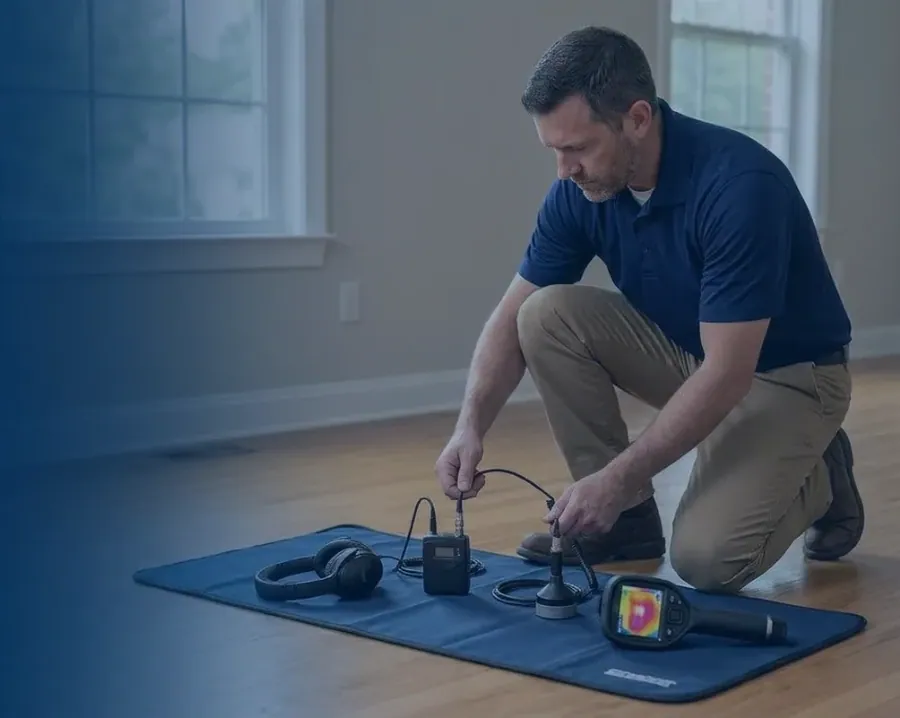
Leak detection in the Marietta area is normally charged as a flat diagnostic fee, separate from any repair. One metro Atlanta specialist publishes a flat rate starting at $400 that covers acoustic listening, thermal scanning, moisture detection and written documentation. Pool and gas leak work is usually priced separately. Ask what the fee includes, whether it is credited against a repair, and what happens if no leak is found.
More on this: Leak Detection in Marietta, GA
How do I know if I have a hidden water leak?
Turn off every water-using fixture and appliance, then watch the low-flow indicator on your water meter. If it moves at all, water is escaping. Record the reading, wait one to two hours without using water, and read it again. Any change confirms a leak. Closing the main house valve and re-checking tells you whether the leak is inside the house or out at the service line.
More on this: Leak Detection in Marietta, GA
Can a leak under a concrete slab be found without breaking the floor?
Yes. That is the entire purpose of professional leak detection. Pressure testing confirms which line is losing water, a line locator maps where the pipe runs, and acoustic ground microphones pick up the sound of water escaping under the concrete. Thermal imaging or tracer gas confirms the spot. Only then is a small section opened, rather than exploratory demolition.
More on this: Leak Detection in Marietta, GA
Does Cobb County give a credit for a high water bill caused by a leak?
Yes, partially. Cobb County Water System offers a partial leak credit once in a rolling 12-month period, applied to no more than two affected months. You must submit your account address and number, an explanation of the leak, and a plumbing repair receipt, a parts receipt, or at minimum a letter explaining what was done to fix it. Pool leaks also require the pool volume. You must keep paying the bill while the claim is processed.
More on this: Leak Detection in Marietta, GA
Where are you based?
2722 Sandy Plains Rd, Marietta, GA 30066. We cover Marietta and Cobb County, plus the surrounding communities of Kennesaw, Smyrna, Acworth, Powder Springs, Austell and Mableton.
More on this: About Marietta Leak Locators
Do you repair leaks as well as find them?
Contact us to discuss what a particular job involves. Detection and repair are separate pieces of work and are quoted separately, because until a leak is located nobody can honestly price the repair.
More on this: About Marietta Leak Locators
Will I get documentation of what you find?
Yes. Written documentation of the leak location, the methods used and the probable cause is part of the job. You need it for a water utility leak credit application and for any insurance claim.
More on this: About Marietta Leak Locators
What areas do you cover?
Marietta and Cobb County including East Cobb, West Cobb, the Square area, Sandy Plains, Powers Ferry, Fair Oaks and Indian Hills, across ZIP codes 30008, 30060, 30062, 30064, 30066, 30067 and 30068, plus Kennesaw, Smyrna, Acworth, Powder Springs, Austell and Mableton.
More on this: About Marietta Leak Locators
What is your phone number?
(470) 458-0795. We are open Monday to Friday 7:00am to 7:00pm and Saturday 8:00am to 5:00pm.
More on this: Contact Marietta Leak Locators
Where are you located?
2722 Sandy Plains Rd, Marietta, GA 30066, covering Marietta and Cobb County.
More on this: Contact Marietta Leak Locators
Is there an online form I can fill in instead?
No, and that is deliberate. A leak is a diagnostic problem and a form cannot ask the follow-up question. Two minutes on the phone usually narrows the cause more than a form ever would, and sometimes tells you it is something you can fix yourself.
More on this: Contact Marietta Leak Locators
What should I have ready when I call?
Your water meter reading and whether the low-flow indicator is turning with everything off, and whether it still turns with the main house shut-off valve closed. That second answer tells us immediately whether to look inside the house or out at the buried service line.
More on this: Contact Marietta Leak Locators
Signs and symptoms
Why do I hear running water when nothing is on?
Because water is moving through your plumbing, and in a closed system with every fixture off, the only thing that moves water is a leak. Since you can hear it, it is a pressurized supply line,most often a toilet flapper, a slab leak, a leak inside a wall, or the buried service line.
More on this: Hearing Running Water With Everything Off
Could it just be a toilet?
Very possibly, and it is the cheapest thing to rule out. Put food coloring in each tank, wait twenty minutes without flushing, and check the bowls. Color appearing in the bowl means that flapper is leaking and is likely your noise.
More on this: Hearing Running Water With Everything Off
What causes a warm spot on a floor?
In a slab home, most often a hot water supply line leaking under the concrete, warming the slab above. Other explanations worth ruling out are sunlight through a window, a heating duct under the floor, radiant heating, a nearby appliance, or an electrical fault.
More on this: Warm Spot on the Floor
How do I confirm it is a hot water slab leak?
Close the cold supply valve into the water heater and watch the water meter. If the meter keeps moving with the hot side isolated, the leak is on the hot run, which matches a warm patch on the floor.
More on this: Warm Spot on the Floor
Why is water coming up through my concrete floor?
Either a plumbing line under the slab is leaking, or groundwater is being forced up through the concrete from outside. The water meter distinguishes them: if it turns with every fixture off, it is your plumbing.
More on this: Water Coming Up Through the Foundation
How do I know if it is groundwater or a leak?
Groundwater correlates with rainfall, is usually worst at exterior walls and corners, is always cold, and does not affect your water bill. A plumbing leak continues in dry weather, often appears mid-room, can be warm if it is a hot line, and shows up on the meter and the bill.
More on this: Water Coming Up Through the Foundation
Why did my water pressure suddenly drop?
Usually water escaping before it reaches your fixtures, a valve that has partly closed or failed, or utility work on the main. Check with a neighbor first, if their pressure dropped too, it is the utility rather than your plumbing.
More on this: Sudden Drop in Water Pressure
Is low water pressure a sign of a leak?
It can be, particularly if the whole house is affected and the water meter turns with everything off. A large leak diverts volume before it reaches the fixtures. Low pressure combined with a rising water bill is a strong indicator.
More on this: Sudden Drop in Water Pressure
Why is one patch of my lawn always wet with no rain?
Something underground is watering it, most often a buried water service line leak, an irrigation lateral leak, or a sewer lateral leak. The meter test tells you whether it is coming from your pressurized supply.
More on this: Wet Spot in the Yard With No Rain
How do I tell a water leak from a sewer leak in the yard?
Smell and the meter. A supply line leak produces clean water, no odor, and a meter that keeps turning with everything off. A sewer leak often produces an odor and unusually lush dark green growth, and does not affect the water meter at all.
More on this: Wet Spot in the Yard With No Rain
Why is my carpet wet with no visible leak?
The water is most likely arriving from underneath, a slab leak, a drain line failure below the floor, or groundwater, or traveling along framing from a leak elsewhere in the house and surfacing where gravity lets it.
More on this: Damp Carpet With No Visible Leak
How do I tell a supply leak from a drain leak under the floor?
Timing. A supply line is pressurized constantly, so it produces constant dampness. A drain leak only appears while water is flowing through that drain: after a shower, a bath or a washing machine cycle.
More on this: Damp Carpet With No Visible Leak
Types of leak
What are the signs of a slab leak?
A warm or hot patch on the floor, the sound of running water when everything is off, a water bill climbing steadily, damp carpet or buckling flooring with no visible source, a drop in water pressure, a musty smell in one area, and new hairline cracks in the slab or walls.
More on this: Slab Leak Detection in Marietta, GA
Can a slab leak be found without breaking the floor?
Yes, that is the point of professional detection. Pressure testing identifies which line is losing, a locator traces where the pipe runs, acoustic ground microphones hear the escaping water through the concrete, and thermal imaging or tracer gas confirms the spot. Only a small area is then opened.
More on this: Slab Leak Detection in Marietta, GA
How do I know if my water service line is leaking?
Close the main shut-off valve where the water enters the house, then watch the meter. If it still turns, water is escaping between the meter and that valve, the buried service line. Supporting signs are a soggy or unusually green strip of lawn, water in the meter box, or water surfacing at the curb.
More on this: Water Line Leak Detection in Marietta, GA
Who is responsible for the water line from the meter to the house?
The homeowner. The utility maintains the main and the meter; everything on the house side of the meter is the property owner's responsibility, including the buried service line, the irrigation tee and all interior plumbing.
More on this: Water Line Leak Detection in Marietta, GA
Is my pool leaking or just evaporating?
Losing roughly a quarter to half an inch a day in summer is normal evaporation in this climate. Consistently more than that suggests a leak. The bucket test confirms it: a bucket of water placed on a pool step loses water to evaporation at the same rate as the pool, so if the pool drops faster than the bucket, you have a leak.
More on this: Pool Leak Detection in Marietta, GA
How do I do the bucket test?
Fill a bucket with pool water and set it on a step so the water inside sits at roughly the same level as the pool. Mark the water level inside and outside the bucket. Leave the pool running normally for 24 hours, then compare. If the pool level dropped more than the bucket level, the difference is your leak.
More on this: Pool Leak Detection in Marietta, GA
What should I do if I smell gas in my house?
Leave immediately with everyone in the building. Do not switch anything electrical on or off, do not use a phone inside, and do not try to find the source. From outside and well clear of the property, call 911 and your gas utility. Do not return until you are told it is safe.
More on this: Gas Leak Detection in Marietta, GA
What does a gas leak smell like?
Rotten eggs or sulphur. Natural gas is naturally odorless, so utilities add a chemical called mercaptan specifically so leaks can be smelled. If you notice that smell, treat it as real.
More on this: Gas Leak Detection in Marietta, GA
What are the signs of a sewer line leak?
A persistent sewer or sulphur smell indoors or outside, repeated slow drains or backups across several fixtures, gurgling from drains and toilets, a patch of lawn that is unusually lush, soggy or sunken along the lateral route, and increased insect activity in one area.
More on this: Sewer Leak Detection in Marietta, GA
Why can't acoustic equipment find a sewer leak?
Because drain lines are not pressurized. Acoustic detection listens for the hiss of water escaping under pressure, which a drain line does not produce. Drain leaks are found instead with camera inspection, smoke testing, dye testing and hydrostatic testing.
More on this: Sewer Leak Detection in Marietta, GA
How do I know if my sprinkler system is leaking?
Turn the controller fully off. Close the main house shut-off valve but leave the irrigation supply open, then watch the meter. If it moves, the leak is on the irrigation line. Close the irrigation supply too: if the meter then stops, the system is confirmed as the source.
More on this: Irrigation Leak Detection in Marietta, GA
Why does an irrigation leak waste so much water?
Because it is underground, on an automatic schedule, usually overnight, and produces no indoor symptoms at all. A cracked lateral or a valve that fails to close fully runs continuously for weeks before anything visible appears at the surface.
More on this: Irrigation Leak Detection in Marietta, GA
How leaks are actually found
What is acoustic leak detection?
A method of locating pressurized water leaks by listening for the continuous high-frequency sound water makes escaping through a small opening. Ground microphones amplify that sound at the surface, and correlators calculate the leak's position from the time difference between two sensors on the line.
More on this: Acoustic Leak Detection
Does acoustic detection work on plastic pipe?
Less well than on metal. Plastic damps the leak sound, so the effective listening range is much shorter. It still works, but it usually needs to be combined with more precise line tracing and often confirmed with tracer gas.
More on this: Acoustic Leak Detection
Can thermal imaging see through walls?
No. It reads surface temperature. What it detects is the temperature difference that moisture or a hot water line creates on the surface above, which is enough to show the pattern, but it is not an X-ray.
More on this: Thermal Imaging Leak Detection
Does thermal imaging work for cold water leaks?
It can, through evaporative cooling of the surrounding material, but it is harder than finding a hot water leak. If the wet area is close to room temperature there may be no usable contrast, which is when moisture meters and acoustic listening take over.
More on this: Thermal Imaging Leak Detection
What is tracer gas leak detection?
A method where a safe, inert gas, usually about 5% hydrogen in nitrogen, or helium, is introduced into a drained, isolated pipe. The gas escapes through the leak and rises to the surface, where a sensitive detector locates it. It finds leaks too small or too quiet for acoustic methods.
More on this: Tracer Gas Leak Detection
Is tracer gas safe to use in my home?
Yes. The standard hydrogen-nitrogen mixture sits well below the flammable threshold and is non-toxic and non-corrosive; helium is inert. Neither leaves residue in the plumbing.
More on this: Tracer Gas Leak Detection
What is a plumbing pressure test?
A section of plumbing is isolated, brought to a known pressure and monitored with a gauge. A line that holds pressure is not leaking; a line that loses pressure is. The rate of loss indicates roughly how large the leak is.
More on this: Pressure Testing
Why is pressure testing done before acoustic detection?
Because it is faster and cheaper, and it eliminates large parts of the system in minutes. That way the slower, more expensive methods are only used on the section that is definitely losing water.
More on this: Pressure Testing
What is a sewer camera inspection?
A camera on a flexible rod is fed through the drain or sewer line, recording its condition from the inside: cracks, joint offsets, root intrusion, bellies, scale and collapses. A transmitter in the camera head lets the operator mark the exact position and depth from the surface.
More on this: Video Pipe Inspection
When should I get a camera inspection?
After repeated backups in the same line, when there is a sewer smell with no visible source, before buying an older property with mature trees over the lateral, before committing to a trenchless repair, and after a repair to verify the work.
More on this: Video Pipe Inspection
Can a leak really be found without digging?
The detection is genuinely non-invasive, pressure testing, line tracing, acoustic listening, thermal imaging and tracer gas locate the leak without opening anything. The repair still requires access to the pipe. The saving is that one small targeted opening replaces exploratory demolition.
More on this: Leak Detection Without Digging
So something still has to be opened?
For the repair, yes. A broken pipe under a slab has to be reached. But a targeted opening at a confirmed location is a fraction of the cost and damage of opening the floor in several places hoping to find it.
More on this: Leak Detection Without Digging
Water bills, credits and insurance
Is leak detection free if I have you do the repair?
It depends on the company. Some credit the diagnostic fee against the repair, some do not, and some detection-only specialists do not perform repairs at all. Ask this specific question before the visit rather than assuming either way.
More on this: What Leak Detection Costs in Marietta, GA
What if the leak cannot be found?
Policies vary, which is why you should ask up front. A competent specialist should at minimum document what was ruled out, which lines hold pressure, which zones were eliminated, because that narrows the problem substantially even when the exact point is not found on the first visit.
More on this: What Leak Detection Costs in Marietta, GA
Is detection or repair the bigger cost?
Repair, almost always. Detection is a fixed diagnostic. Repair cost swings widely with access: a slab leak reached through a small opening in a utility room is a different job from one under a tiled kitchen island. That is exactly why nobody can quote the repair before the leak is located.
More on this: What Leak Detection Costs in Marietta, GA
Why is my water bill suddenly so high with no change in usage?
Because water is leaving your system somewhere you cannot see. The most common causes are a silently running toilet, an underground irrigation leak, a buried service line failure, or a leak under the slab. The water meter test confirms it: with every fixture and appliance off, any movement of the low-flow indicator means water is escaping.
More on this: High Water Bill in Marietta, GA
How do I test for a leak with my water meter?
Turn off every tap, appliance, icemaker and irrigation zone and do not flush a toilet. Find the meter, usually in a covered box near the curb. If the small triangle or dial turns at all, water is moving. Record the reading, wait one to two hours without using water, and read again, any change confirms a leak.
More on this: High Water Bill in Marietta, GA
Does Cobb County give credit for a high water bill caused by a leak?
Yes, partially. Cobb County Water System offers a partial leak credit once in a rolling 12-month period, applied to no more than two affected months. You must supply your account address and number, an explanation of the leak, and a plumbing repair receipt, a parts receipt, or a letter explaining what was done. Pool leaks also require the pool volume.
More on this: High Water Bill in Marietta, GA
What is a water leak adjustment?
It is a partial credit a water utility applies to a bill that was inflated by a plumbing leak, once the leak has been repaired and documented. It is not a refund of the whole overage. Cobb County Water System describes its own as a partial offset of the costs associated with certain plumbing failures, rather than full compensation for the cost of a leak.
More on this: Cobb County Water Leak Adjustment
Can a water leak drastically increase your water bill?
Yes, by hundreds of dollars or more. One Cobb County household reported 89,000 gallons producing a bill of roughly $1,400. That volume does not come from a dripping tap: it comes from a continuous leak running unnoticed for weeks, typically a service line, an irrigation lateral, a slab leak or a toilet that never stops filling.
More on this: Cobb County Water Leak Adjustment
Who is responsible for water leaks outside the house?
The meter is the dividing line. The utility maintains the main and the meter. Everything on the house side of it is the property owner's responsibility, which includes the buried water service line, the irrigation tee, the hose bibs and all interior plumbing. That is why a buried leak outside still appears on your bill and is still yours to repair.
More on this: Cobb County Water Leak Adjustment
Does Marietta Power & Water give a credit for a water leak?
City of Marietta utility customers apply to Marietta Power & Water, which runs its own leak credit process separate from Cobb County's. Confirm the current terms, limits and forms directly with the utility, as published policies change.
More on this: Marietta Power & Water Leak Credit
How do I know whether I am a city or county water customer?
Check the utility name printed on your bill. Marietta Power & Water customers are inside the City of Marietta service area, often on a combined electric and water bill. A Marietta mailing address on its own does not mean you are a city utility customer, much of the Marietta mailing area is billed by Cobb County Water System.
More on this: Marietta Power & Water Leak Credit
Is the Marietta process the same as the Cobb County one?
No. They are two separate utilities with separate applications and separate terms. Cobb County's published policy allows a partial credit once per rolling 12-month period across no more than two affected months. Marietta Power & Water sets its own terms, so confirm them with the city.
More on this: Marietta Power & Water Leak Credit
Questions from the guides
How much is water per gallon in Cobb County in 2026?
Residential water is tiered: $3.85 per 1,000 gallons for the first 3,000, rising through $5.95, $7.40 and $8.66, to $11.25 per 1,000 gallons above 50,000. Wastewater adds $7.51 per 1,000 gallons, and there is an $8.00 monthly service charge on a standard household meter.
More on this: What a Leak Actually Costs on a Cobb County Water Bill
Do I pay sewer charges on water that leaked into the ground?
On a standard residential account, yes. The meter measures water leaving the main, not water arriving at the sewer, so leaked gallons are normally billed for both. That is why the effective cost of leaked water in the top tier is closer to $18.76 per 1,000 gallons.
More on this: What a Leak Actually Costs on a Cobb County Water Bill
Is Cobb County water hard or soft?
Soft. The Cobb County-Marietta Water Authority reports average hardness of around 38 mg/L as calcium carbonate, with a pH of about 7.9. Soft, non-acidic water forms very little protective scale inside copper pipe, but it is not itself corrosive.
More on this: Copper Pinhole Leaks in Cobb County Homes
Does Cobb County use chloramine in the water?
No. CCMWA uses sodium hypochlorite for disinfection, not chloramines. This matters because the chloramine-corrosion explanation that appears in a lot of plumbing content does not apply to Cobb County homes.
More on this: Copper Pinhole Leaks in Cobb County Homes
Is a water leak the landlord's responsibility in Georgia?
The plumbing and the repair normally are, because they are part of the property. The water bill follows whoever holds the utility account. Check the lease, because responsibility for the bill and responsibility for the pipe are two different things.
More on this: Who Pays for Leak Detection in a Rental?
My landlord will not fix a leak. What can I do?
Report it in writing and keep the record. Run the meter test and photograph the result so you have evidence rather than an impression. Georgia landlord-tenant rules on repairs and remedies are specific, so if the leak is causing damage or making the property unfit, take legal advice rather than withholding rent on your own initiative.
More on this: Who Pays for Leak Detection in a Rental?
At what temperature do pipes freeze in Georgia?
Water freezes at 32°F, but an exposed pipe needs sustained cold to reach that point. A brief overnight dip rarely matters. A full day or more below freezing, particularly with wind through an open crawlspace, is what causes failures on Georgia houses.
More on this: How to Protect Your Pipes From a Georgia Hard Freeze
Should I leave taps dripping during a freeze in Marietta?
A slow trickle from the furthest fixture helps, because moving water is harder to freeze and an open tap relieves the pressure that splits pipes. Be aware that Cobb County excludes water from faucets left dripping in freezing weather from its leak credit, so those gallons are yours.
More on this: How to Protect Your Pipes From a Georgia Hard Freeze
How do I know if my toilet is leaking?
Put a few drops of food coloring in the tank, wait twenty minutes without flushing, then look in the bowl. Color in the bowl means the flapper is letting water through. Also lift the lid and check the water level is below the top of the overflow tube.
More on this: Is a Running Toilet Behind Your High Water Bill?
How much water does a running toilet waste?
A silently leaking flapper wastes thousands of gallons a year. The EPA reports that a stuck fill valve can waste up to 4,300 gallons a day, which at Cobb County's top-tier water and sewer rates is over $1,000 in a single month.
More on this: Is a Running Toilet Behind Your High Water Bill?
Is a leaking water heater an emergency?
Water pooling under the tank is urgent but not usually a same-minute emergency: close the cold supply valve above the heater and the loss stops. A tank that has split and is discharging freely, or any water near electrics, is an emergency and the main shut-off is the first move.
More on this: Water Heater Leaking? What to Check First
Can a water heater cause a high water bill?
Yes, most often through a temperature and pressure relief valve that is weeping into its discharge pipe. The water goes straight to a drain, so nothing pools and nothing is visible, but every gallon is metered.
More on this: Water Heater Leaking? What to Check First
Areas we cover
Why are polybutylene leaks so common in East Cobb?
Because a large share of East Cobb was built between 1978 and 1995, the exact window when polybutylene supply pipe was installed across Georgia. The material degrades from the inside and fails at the fittings without warning, and much of that pipe is still in service.
More on this: Leak Detection in East Cobb
My West Cobb house is newer. Can it still have a leak?
Yes, just a different kind. Newer homes fail at workmanship points rather than from age, fittings that were never fully seated, unregulated water pressure, and physical damage from landscaping or construction work.
More on this: Leak Detection in West Cobb
Am I billed by the city or the county near Marietta Square?
Usually by Marietta Power & Water, because the Square area sits inside the City of Marietta utility service area. That matters because the city and Cobb County run entirely separate leak credit processes. Check the utility name printed on your bill.
More on this: Leak Detection near Marietta Square
Do you cover the Sandy Plains Road area?
Yes, our address is 2722 Sandy Plains Rd, Marietta, GA 30066, so this corridor and the subdivisions either side of it are effectively our doorstep.
More on this: Leak Detection on Sandy Plains
Water is coming through my condo ceiling. Is it my leak?
Often not. In stacked units water travels along joists and through penetrations before it appears, so the leak usually originates at least one floor above and frequently in a different unit. Moisture mapping across units establishes where it actually started.
More on this: Leak Detection in the Powers Ferry Area
Why is my water pressure low in an older Fair Oaks home?
Most often corroded galvanized steel supply pipe. It rusts internally over decades, progressively narrowing the bore until pressure drops noticeably. Perforation usually follows, so low pressure in original galvanized pipe is a warning rather than just an inconvenience.
More on this: Leak Detection in Fair Oaks
Why do copper pipes develop pinhole leaks?
Copper corrodes slowly from within and from outside where it contacts concrete and soil. After forty-plus years, particularly on hot runs and under slabs, pinholes begin to form. The failure is gradual: a weep that produces a steadily climbing bill long before anything becomes visible.
More on this: Leak Detection in Indian Hills
Do you cover the 30060 ZIP code?
Yes. Marietta 30060 covers the area immediately south and west of the Square, and it is within our regular Marietta and Cobb County service area.
More on this: Leak Detection in 30060
Do you cover the 30062 ZIP code?
Yes. Marietta 30062 covers central and eastern Marietta, taking in a large part of East Cobb, and it is within our regular Marietta and Cobb County service area.
More on this: Leak Detection in 30062
Do you cover the 30064 ZIP code?
Yes. Marietta 30064 covers western Marietta and the approach to West Cobb, and it is within our regular Marietta and Cobb County service area.
More on this: Leak Detection in 30064
Do you cover the 30066 ZIP code?
Yes. Marietta 30066 covers north-eastern Marietta along the Sandy Plains and Canton Road corridors, and it is within our regular Marietta and Cobb County service area.
More on this: Leak Detection in 30066
Do you cover the 30067 ZIP code?
Yes. Marietta 30067 covers southern Marietta toward Powers Ferry, Delk Road and the I-75 corridor, and it is within our regular Marietta and Cobb County service area.
More on this: Leak Detection in 30067
Rather talk it through first?
No forms and no waiting for a callback. Speak to a technician, describe what you are seeing, and get a straight answer about what it takes to find it.
Your question is not on this page
The quickest route is to describe what you are seeing. A running-water sound with everything off, a warm patch on a floor, a bill that doubled, a pool dropping more than a quarter inch a day: each of those points somewhere specific, and a two-minute conversation usually narrows it further than any article can. If you want to do one thing first, run the water meter test, then call with the result.