
Last reviewed and updated: 2026-09-24
Indian Hills is an established East Cobb golf community developed largely between the 1960s and 1980s. The housing has reached the age where original copper supply lines, including those run under slabs: begin producing pinhole failures, and the area's high pool and irrigation density adds a second and third category of leak on top of that.
Ageing copper, decades-old pools and heavy irrigation overlap here, so pool leak detection and irrigation leaks are a large share of the work, alongside slab leaks in the older stock.
What makes Indian Hills different
- Development era: principally 1960s through 1980s
- Foundations: a mix, with basements common on the sloping golf course lots
- Likely pipe: copper predominantly, with polybutylene in the later phases
- Pools: high density, much of it original and now decades old
- Irrigation: extensive, on large landscaped lots
- Water utility: Cobb County Water System
Copper at the age where it fails
Copper supply pipe installed in the 1960s and 1970s is now past the point where pinhole corrosion becomes common, particularly on hot runs and particularly where the pipe was run through or under a slab. The failure pattern is slow: a pinhole weeps for weeks or months, producing a steadily climbing water bill and eventually a damp or warm patch, rather than a sudden break.
The later phases of the community carry polybutylene instead, with its own and very different failure pattern: sudden, at the fittings, with no warning at all.
The leak profile here
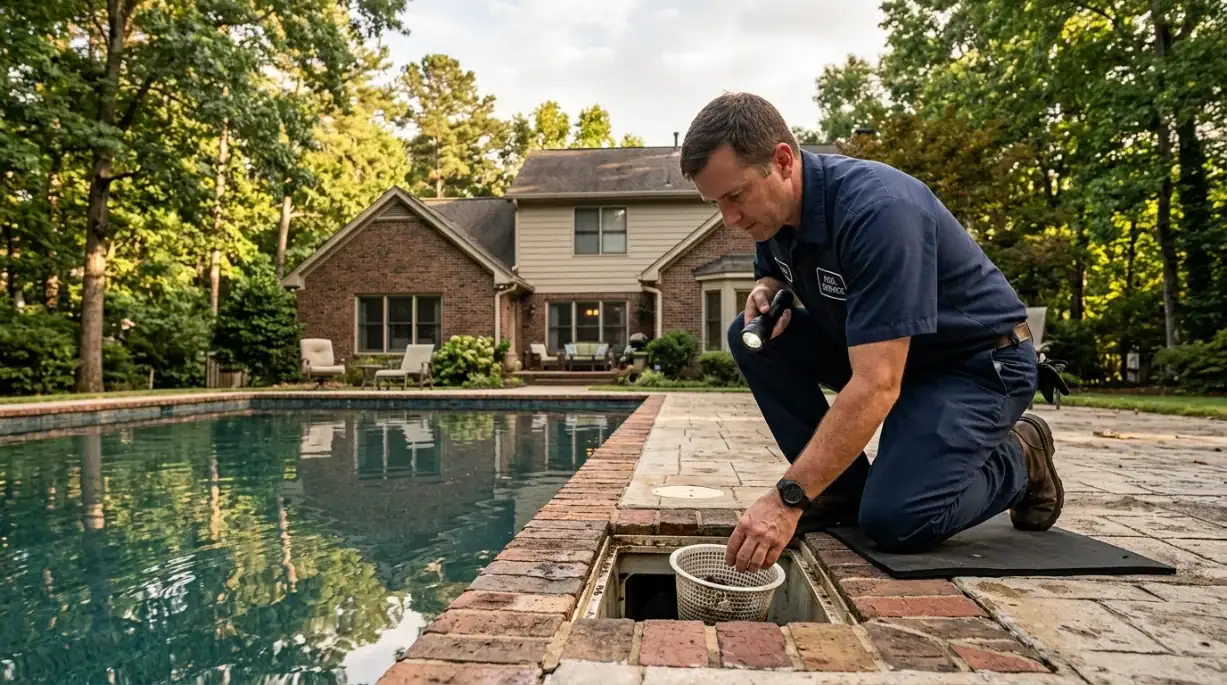
Three overlapping sources of work here. Ageing copper producing slab and in-wall pinhole leaks. Pools, many now decades old with original skimmers, light niches and plumbing. And extensive irrigation across large landscaped lots, where a cracked lateral or a valve that will not seat runs overnight and unseen.
| Most common leak type | Why, in this area |
|---|---|
| Copper pinhole leaks | 1960s-70s copper now well past forty years in service |
| Hot-side slab leaks | Copper run under slabs in the earlier phases |
| Pool leaks | High density, much of it original and decades old |
| Irrigation leaks | Extensive systems on large landscaped lots |
| Polybutylene failures | Confined to the later phases of the community |
| Sewer root intrusion | Mature landscaping over ageing laterals |
Which water utility bills you here
Indian Hills is served by Cobb County Water System, so the county leak adjustment applies. Note the pool-specific requirement: a pool leak claim must include the pool volume alongside the account details, explanation of the leak and proof of repair. Worth recording your pool volume now rather than looking for it later.
Lot and landscape notes
The community sits off Lower Roswell Road and Indian Hills Parkway, on lots that slope toward the course in many sections. That slope matters for diagnosis: water from a buried leak travels downhill before surfacing, so a wet area near the bottom of a lot frequently originates well above it. Extensive mature landscaping also means irrigation runs are long and sewer laterals sit under established root systems.
Frequently asked questions
Why do copper pipes develop pinhole leaks?
Copper corrodes slowly from within and from outside where it contacts concrete and soil. After forty-plus years, particularly on hot runs and under slabs, pinholes begin to form. The failure is gradual: a weep that produces a steadily climbing bill long before anything becomes visible.
Do I need my pool volume for a water bill credit?
Yes, for a Cobb County leak adjustment on a pool leak. The county requires the pool volume in addition to your account details, an explanation of the leak, and proof the repair was carried out. It is worth recording it now rather than trying to establish it later.
My lot slopes. Does that affect finding a buried leak?
Yes. Water follows the slope underground before surfacing, so a wet area near the bottom of a sloping lot frequently originates well above it. Line tracing and correlation locate the actual break rather than the place the water happens to emerge.
Is my Indian Hills home copper or polybutylene?
It depends on the phase. The earlier 1960s-70s sections are predominantly copper; later phases built into the 1980s and beyond may carry polybutylene. Check at the water heater and the main shut-off: gray flexible plastic pipe, often stamped PB2110, is polybutylene.
How old is too old for pool plumbing?
There is no fixed age, but pools past roughly twenty-five to thirty years with original skimmers, light niches and plumbing are where most pool leak calls originate. Those components fail before the shell does.