
Last reviewed and updated: 2026-09-28
Acworth sits north-west of Marietta toward Lake Allatoona, and its housing is largely 1990s onwards, with lakeside and older downtown pockets. That build profile determines what leaks turn up: pipe material tracks construction date closely, and foundation type decides how quickly a leak reveals itself. Acworth is served by Cobb County Water System, so the county's leak adjustment process applies once a leak is repaired and documented.
Leak detection in Acworth at a glance
- Location: north-west of Marietta toward Lake Allatoona
- Housing era: largely 1990s onwards, with lakeside and older downtown pockets
- Water utility: Cobb County Water System
- Leak credit: partial, once per rolling 12-month period, maximum two affected months, proof of repair required
- First step: the water meter test, free, and it confirms whether a leak exists
Housing in Acworth and what it means
Acworth's housing is largely 1990s onwards, with lakeside and older downtown pockets. Pipe material follows build date closely: roughly 1978-1995 means polybutylene is likely, the 1960s to 1980s often means copper run under slabs, and anything older can still carry galvanized steel supply and cast iron drains.
The leak profile here
The leaks most often found in Acworth:
- Irrigation and service line leaks on larger lots
- Pool leaks in the lakeside subdivisions
- Polybutylene in the early-1990s sections
- Crawlspace and freeze damage in the older downtown stock
In practice that means the same work we do across Marietta, done in Acworth: slab leak detection under concrete, water service line leaks between the meter and the house, pool leak detection, irrigation leaks and sewer and drain problems. A slab leak in Acworth behaves exactly as it does in Marietta, because the housing eras and the red clay underneath are the same.
| Most common leak type | Why, in this area |
|---|---|
| Irrigation and service line leaks on larger lots | Irrigation and service line leaks on larger lots |
| Pool leaks | Pool leaks in the lakeside subdivisions |
| Polybutylene | Polybutylene in the early-1990s sections |
| Crawlspace and freeze damage | Crawlspace and freeze damage in the older downtown stock |
Everything between the meter and the house
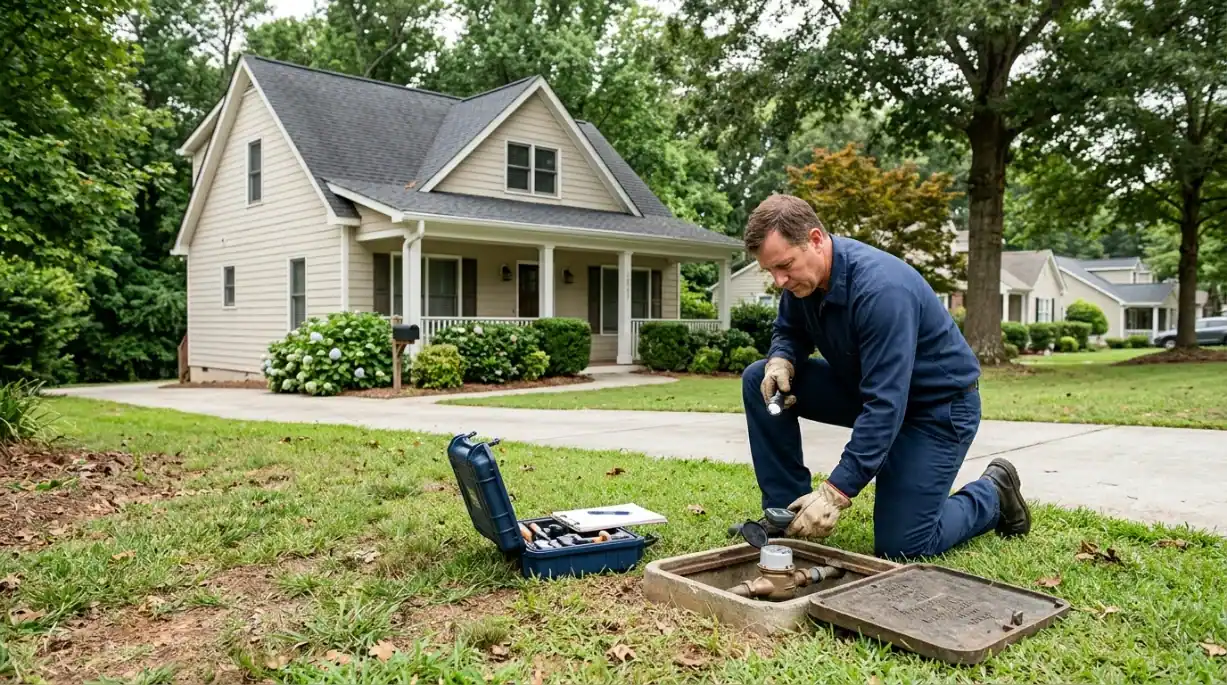
A large share of the expensive leaks in this part of Cobb County are never inside the house at all. The service line, the irrigation tee, the hose bibs and the pool feed all sit on the homeowner's side of the meter.
These leak quietly into soil, so there is nothing to hear indoors and nothing to see until the ground gives it away. Lot size matters: a long run from the street means more pipe, and more distance for water to travel before it surfaces.
The test is simple. Close the main house valve. If the meter still turns, the leak is outside, and the irrigation supply is the next thing to isolate.
Want the leak found before anything is opened?
Acoustic listening, thermal imaging, pressure testing and tracer gas narrow it to a few inches first, so only that area has to be touched.
The seasonal pattern in the bills
A bill that climbs every spring and settles every autumn is almost never a plumbing failure. It is irrigation, either a genuine leak in a lateral or a controller running longer than anyone thinks.
A bill that jumps in winter and stays up is the opposite story: a line that froze, split and is now running continuously somewhere out of sight. Cobb County excludes faucets deliberately left dripping in freezing weather from its leak credit, treating that volume as normal use.
Comparing the same month across two years separates a usage change from a leak faster than any other check, and it costs nothing but a look at old bills. The high water bill page works through the rest.
Additions, remodels and the joints between eras
Plumbing in an older house is rarely one system. It is the original pipe, plus whatever a 1980s bathroom addition used, plus a partial repipe someone did after a failure, plus the drain lines underneath all of it.
Every junction between two eras is a potential failure point, and the joint between dissimilar metals is worse than either metal alone: copper connected directly to galvanized steel corrodes at the connection far faster than the pipe on either side.
It is also why a leak in a house like this is often not where the age of the house suggests. The newest pipe, badly joined to the oldest, fails first. Concealed leaks like these are mapped rather than guessed at.
Which water utility bills you here
Acworth is served by Cobb County Water System, which allows a partial leak credit once per rolling 12-month period across no more than two affected months. You must supply your account address and number, a brief explanation of the leak, and a plumbing repair receipt, a receipt for parts, or at minimum a letter explaining what was done. Pool leaks also require the pool volume, and you remain responsible for the bill while the claim is processed.
Before you call anyone
Run the water meter test first. With every fixture and appliance off, any movement of the low-flow indicator means water is escaping. Closing the main house shut-off and re-checking then tells you whether the leak is inside the house or out in the buried service line. It costs nothing and it narrows the problem more than any other single step.
We work in Acworth from our Marietta base, so this is part of our regular service area rather than a long call-out. What a visit costs is the same here as anywhere else we cover: see what leak detection costs.
Frequently asked questions
Do you cover Acworth, GA?
Yes. Acworth sits north-west of Marietta toward Lake Allatoona and is within our regular service area from our Marietta base.
What leaks are most common in Acworth?
Irrigation and service line leaks on larger lots, along with pool leaks in the lakeside subdivisions. Housing era and foundation type determine the pattern more than anything else.
Which water utility serves Acworth?
Cobb County Water System, so the county's leak adjustment process applies rather than the Marietta Power & Water one. Confirm by checking the utility name printed on your bill.
How do I check for a leak myself before calling?
Turn off every water-using fixture and appliance, then watch the low-flow indicator on the water meter. Any movement means water is escaping. Close the main house valve and re-check: still moving puts the leak outside, in the buried service line.
Does it matter how old the house is?
More than almost anything else. Build date predicts pipe material, and pipe material predicts the failure mode: polybutylene fails at fittings without warning, copper under a slab fails as a slow pinhole, galvanized steel closes up from the inside before it perforates.