
Last reviewed and updated: 2026-09-24
A concealed leak behind a wall, above a ceiling or under a floor is located by combining moisture mapping, thermal imaging and acoustic listening. Moisture meters map how far the water has spread, thermal imaging reveals the temperature difference a wet cavity or a hot-water line creates, and acoustic equipment pinpoints pressurized leaks. Water travels along framing and pipe runs before it appears, so the visible stain is often well away from the actual source.
A stain is rarely below its source, so moisture mapping and thermal imaging establish where the water actually started. If the floor is wet rather than the ceiling, see damp carpet with no visible leak.
Where hidden leaks show themselves
- A stain on a ceiling or wall: almost never directly beneath the source
- Bubbling, blistering or peeling paint, or wallpaper lifting at a seam
- Soft or spongy drywall, or a section of skirting board that has swollen
- A persistent musty smell in one room with no visible cause
- Warm or cold patches on a wall surface
- Warped, cupping or lifting flooring in one area
- Mold appearing in a corner, behind furniture or around a vanity
Why the stain is not the leak
Water follows the path of least resistance. It runs along the top of a joist, down the outside of a pipe, across a header and through a light fitting, and it appears wherever gravity and framing let it out. Opening the wall under the stain is therefore a coin toss. Mapping the moisture first tells you which way the water is traveling and where it is coming from.
How concealed leaks are located
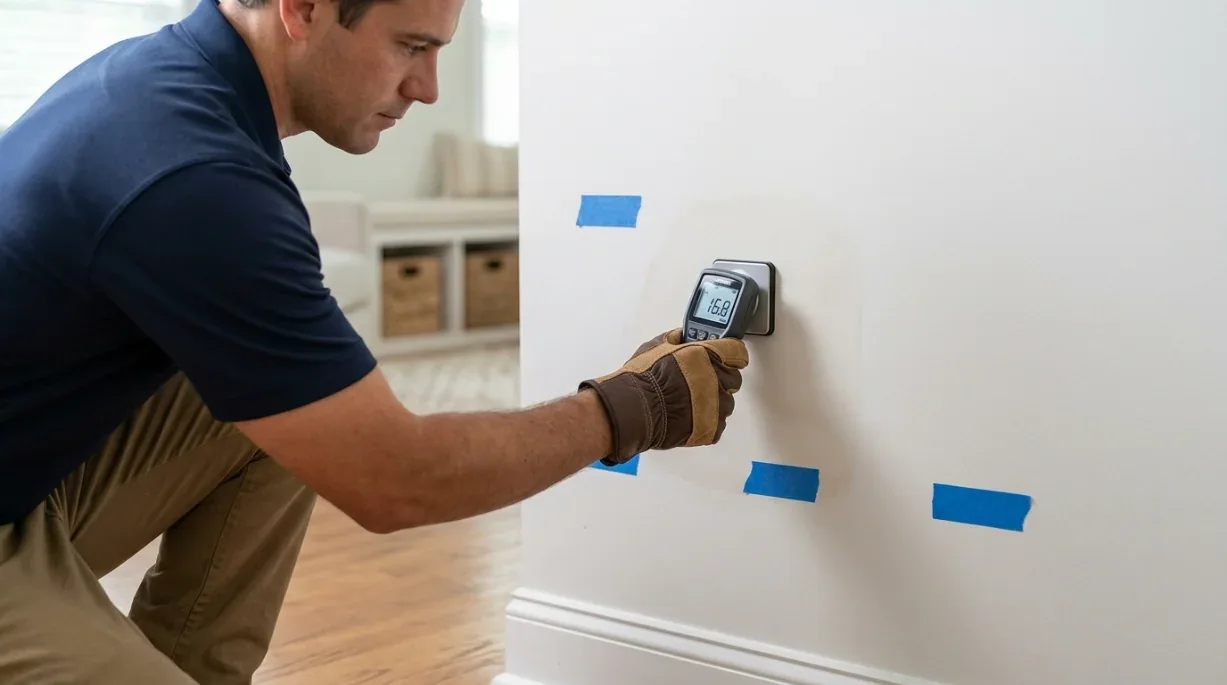
- Map the moisture. Non-invasive meters read moisture through finished surfaces, showing the extent and the direction of travel.
- Scan with thermal imaging. Wet material holds a different temperature from dry material, and a hot water line makes a clear thermal signature through drywall.
- Establish supply or drain. A leak that only appears when a shower or washing machine runs is a drain leak. A leak that runs constantly is a pressurized supply line.
- Pressure test the suspect line to confirm it is losing.
- Listen. Acoustic equipment pinpoints the escape point within the wall cavity.
- Open only the confirmed spot. One small access opening rather than exploratory demolition.
Why concealed leaks get expensive
A visible leak gets fixed. A concealed one runs inside a closed cavity with no airflow, which is close to ideal conditions for mold growth, and it soaks framing and insulation the entire time. The longer it runs, the larger the remediation job becomes, and the more likely an insurer is to characterize the damage as gradual rather than sudden, which is the distinction that decides many claims.
Frequently asked questions
How do you find a leak behind a wall without opening it?
Moisture meters read moisture through finished surfaces to map how far the water has spread, thermal imaging reveals the temperature difference a wet cavity or a hot water line creates, and acoustic equipment pinpoints pressurized leaks. Only the confirmed spot is then opened.
Why is the water stain not directly under the leak?
Because water runs along framing, joists and the outside of pipes until gravity lets it out. It commonly travels several feet before appearing. That is why mapping the moisture matters, it shows the direction of travel back toward the source.
How do I tell a supply leak from a drain leak?
Timing. A supply line is pressurized constantly, so a supply leak runs all the time. A drain leak only appears while water is flowing through that drain: typically after a shower, a washing machine cycle or a sink emptying.
Can thermal imaging see through walls?
Not literally. It reads surface temperature. A wet cavity or a hot water line changes the temperature of the surface above it enough for a thermal camera to show the pattern, which is why it is used alongside moisture meters and acoustic listening rather than on its own.
Is a musty smell always a leak?
Not always, poor ventilation, a failed bathroom extractor or condensation can produce the same smell. But a persistent musty smell localised to one area with no obvious ventilation cause is worth investigating, because a concealed leak in a closed cavity creates close to ideal conditions for mold.
Should I open the wall myself to look?
It is rarely worth it. Because water travels before it appears, the visible stain is a poor guide to the source, so exploratory openings often miss and you pay to repair drywall that was never the problem.