
Last reviewed and updated: 2026-09-28
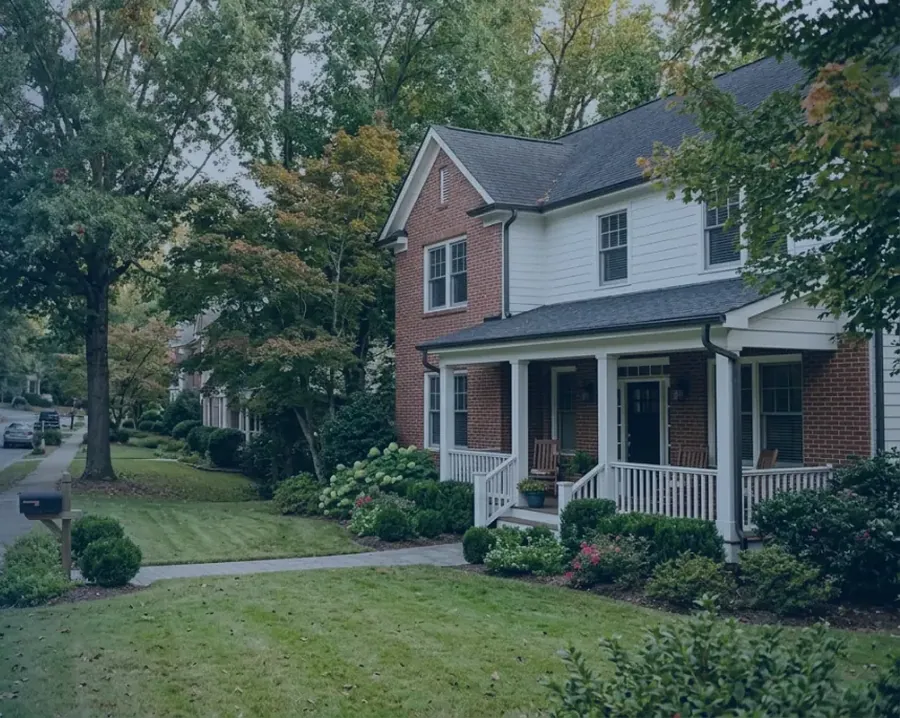
The Whitlock Avenue Historic District is one of Marietta's most significant residential areas,an 82-acre district with 101 contributing buildings, roughly bounded by McCord Street, Oakmont Street, Whitlock Avenue, Powder Springs Road, Trammel Street, Maxwell Avenue and Hazel Street. Its period of significance runs from the antebellum era through the 1930s, taking in Greek Revival, Italianate, Queen Anne, Classical Revival, Dutch Colonial and Craftsman houses.
Plumbing in a house of that age is never one system. It is original work, a mid-century partial repipe, a 1990s bathroom remodel and cast iron drains underneath all of it, and every junction between those layers is a potential failure point.
Older housing, older pipe
In Marietta's established neighborhoods a lot of original plumbing is still in service, and it fails in predictable ways.
Galvanized steel corrodes from the inside, progressively narrowing the bore until pressure drops noticeably, and then it perforates. Falling pressure across the whole house is covered under sudden low water pressure. Low pressure in original galvanized pipe is a warning, not just an inconvenience.
Cast iron drains crack and separate at the joints, which is why older homes often present as a recurring drain problem rather than an obvious leak.
Junctions between materials matter as much as the materials themselves. Where a partial repipe joined copper to galvanized steel, dielectric corrosion attacks that connection, so leaks in these houses often appear exactly where earlier work was done.
Start at the water meter
Before anything else, confirm the leak exists. Turn off every tap, appliance, icemaker and irrigation zone, then find your meter, usually in a covered box near the curb, and watch the low-flow indicator. It is a small triangle, star or dial designed to turn at very low flow rates. If it moves while nothing is running, water is escaping somewhere on your side of the meter.
- Record the full reading and leave the property untouched for one to two hours.
- Read it again. Any change confirms a leak, even if the indicator was moving too slowly to see.
- Close the main house shut-off and re-check. Still moving means the leak is in the buried service line between the meter and the house. Stopped means it is inside or under the house.
- Isolate irrigation separately if you have sprinklers, since they usually tee off before the house valves.
That single test costs nothing and narrows the problem more than anything else you can do yourself.
Slab, crawlspace or basement: it changes everything
The foundation under your house decides how long a leak can hide. It is the most useful thing to know before anyone comes out.
Slab on grade. Supply lines run through or under the concrete. A leak there can run for months producing nothing but a climbing water bill, until a warm patch, cracked tile or damp carpet finally appears. These are slab leaks, located acoustically, through the concrete.
Crawlspace. The pipe is accessible, so a leak usually shows within days, but that same exposure makes the pipe vulnerable to freezing after a hard Marietta winter.
Basement. Water shows quickly, but in a finished basement it has already traveled along joists before appearing, so the ceiling stain is rarely below the actual leak.
Need this looked at today?
Same-day leak location across Marietta and Cobb County. Tell us what the house is doing and we will tell you what happens next.
A bill that jumped, with nothing visible
The most common call is not a flood. It is a water bill that doubled with no change in habits and nothing wrong that anyone can see.
The usual causes, cheapest first: a toilet flapper that no longer seals, an irrigation valve that will not close fully, a buried service line leak draining into the soil, and a supply line failing under a slab. The full order of checks is on the high water bill page. A Cobb County household reported 89,000 gallons producing a bill of roughly $1,400. That volume does not come from a drip. It comes from something running continuously for weeks.
Rule out the toilets first. Food coloring in each tank, twenty minutes without flushing, then look in the bowl. Color in the bowl means that flapper is leaking, and it is a few dollars to fix.
Which water utility bills you here
Neighborhoods in and immediately around the city are typically billed by Marietta Power & Water, often on a combined electric and water bill, rather than by Cobb County Water System. The two utilities run entirely separate leak credit processes, so check the utility name printed on your bill before you apply for anything, sending the application to the wrong one is a common and avoidable delay.
Local notes
The district includes the Reid House by architect Neel Reid and the Maxwell House by G.L. Norrman. Historic designation can affect exterior work, excavation and anything visible from the street, so it is worth establishing early whether a proposed repair route runs into those requirements: it changes which options are realistic before anyone starts planning a trench.
Frequently asked questions
Does historic district status affect a leak repair on Whitlock Avenue?
It can, particularly for exterior work, excavation and anything visible from the street. Establish it early, because it changes which repair routes are realistic, a reroute through the interior may be more straightforward than a trench across a historic frontage.
How old are the houses in the Whitlock Avenue Historic District?
The district's period of significance runs from the antebellum era through the 1930s, across 101 contributing buildings in roughly 82 acres. In plumbing terms that means original galvanized steel and cast iron are still plausible, layered with decades of later repairs.
Why do leaks in old Marietta houses appear where previous work was done?
Dielectric corrosion. Where a partial repipe joined copper directly to galvanized steel, that junction of dissimilar metals corrodes faster than either pipe does on its own, so it becomes the weak point.