
Last reviewed and updated: 2026-09-28
Mableton sits in south Cobb between Smyrna and the Chattahoochee, and its housing is a broad mix from mid-century through recent redevelopment. That build profile determines what leaks turn up: pipe material tracks construction date closely, and foundation type decides how quickly a leak reveals itself. Mableton is served by Cobb County Water System, so the county's leak adjustment process applies once a leak is repaired and documented.
Leak detection in Mableton at a glance
- Location: in south Cobb between Smyrna and the Chattahoochee
- Housing era: a broad mix from mid-century through recent redevelopment
- Water utility: Cobb County Water System
- Leak credit: partial, once per rolling 12-month period, maximum two affected months, proof of repair required
- First step: the water meter test, free, and it confirms whether a leak exists
Housing in Mableton and what it means
Mableton's housing is a broad mix from mid-century through recent redevelopment. Pipe material follows build date closely: roughly 1978-1995 means polybutylene is likely, the 1960s to 1980s often means copper run under slabs, and anything older can still carry galvanized steel supply and cast iron drains.
The leak profile here
The leaks most often found in Mableton:
- Galvanized corrosion in the mid-century housing
- Slab leaks across the later subdivision stock
- Service line leaks on the larger older lots
- Sewer root intrusion under mature trees
In practice that means the same work we do across Marietta, done in Mableton: slab leak detection under concrete, water service line leaks between the meter and the house, pool leak detection, irrigation leaks and sewer and drain problems. A slab leak in Mableton behaves exactly as it does in Marietta, because the housing eras and the red clay underneath are the same.
| Most common leak type | Why, in this area |
|---|---|
| Galvanized corrosion | Galvanized corrosion in the mid-century housing |
| Slab leaks across the later subdivision stock | Slab leaks across the later subdivision stock |
| Service line leaks on the larger older lots | Service line leaks on the larger older lots |
| Sewer root intrusion under mature trees | Sewer root intrusion under mature trees |
The paperwork that decides whether you get money back
The part homeowners most often get wrong is not the detection or the repair. It is closing the job out with nothing in writing.
Both utilities want evidence the problem was corrected: a plumbing repair invoice, a receipt for parts, or at minimum a letter describing what was wrong and what was done. An insurer wants more than that, and wants it before the damage is cleaned up.
Photograph the meter reading, the damp, the opened area and the finished repair. Ask for a written leak detection report before the work closes, not after, because it cannot be recreated once the hole is filled in.
Want the leak found before anything is opened?
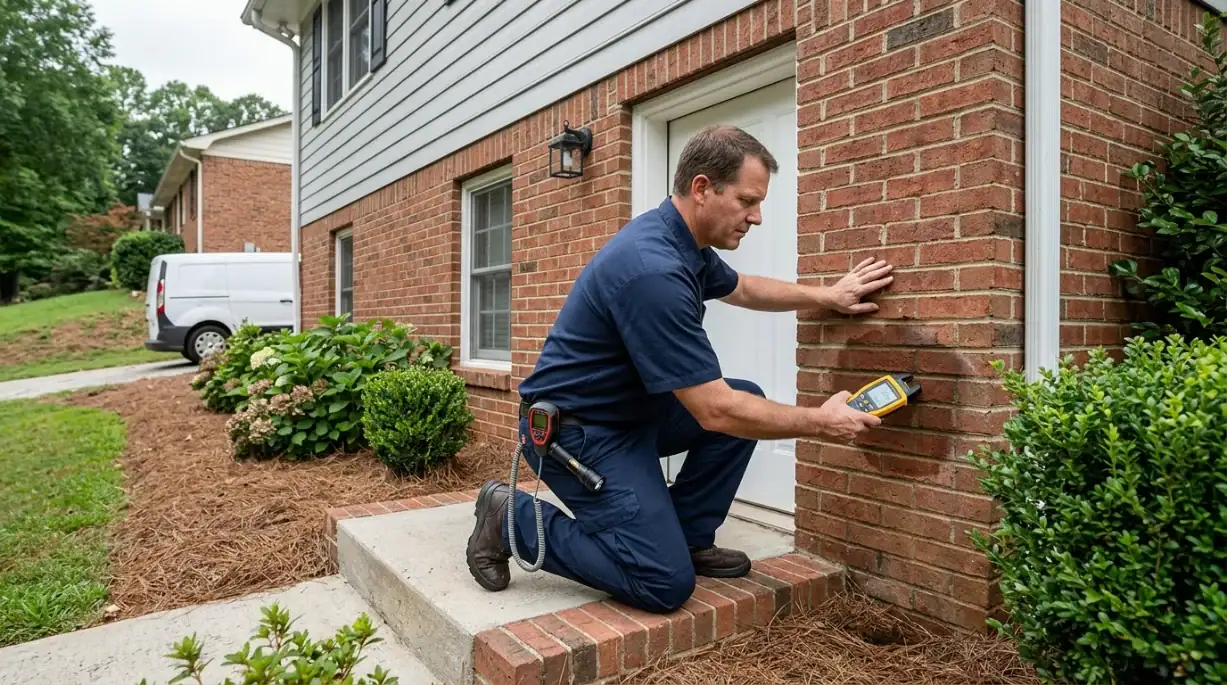
Acoustic listening, thermal imaging, pressure testing and tracer gas narrow it to a few inches first, so only that area has to be touched.
Why leaks here tend to arrive in batches
Streets that went up in a single phase share more than a look. They usually share a builder, a plumbing contractor, a pipe material and an installation date, which means they also share a failure window.
That is why one house having a fitting fail is worth paying attention to two doors down. The whole batch has aged identically, under the same water chemistry and the same ground movement.
It cuts both ways: it makes diagnosis faster, because the likely material and failure mode are already known before anyone arrives, and it makes a neighbor's repair invoice genuinely useful information.
Additions, remodels and the joints between eras
Plumbing in an older house is rarely one system. It is the original pipe, plus whatever a 1980s bathroom addition used, plus a partial repipe someone did after a failure, plus the drain lines underneath all of it.
Every junction between two eras is a potential failure point, and the joint between dissimilar metals is worse than either metal alone: copper connected directly to galvanized steel corrodes at the connection far faster than the pipe on either side.
It is also why a leak in a house like this is often not where the age of the house suggests. The newest pipe, badly joined to the oldest, fails first. Concealed leaks like these are mapped rather than guessed at.
Which water utility bills you here
Mableton is served by Cobb County Water System, which allows a partial leak credit once per rolling 12-month period across no more than two affected months. You must supply your account address and number, a brief explanation of the leak, and a plumbing repair receipt, a receipt for parts, or at minimum a letter explaining what was done. Pool leaks also require the pool volume, and you remain responsible for the bill while the claim is processed.
Before you call anyone
Run the water meter test first. With every fixture and appliance off, any movement of the low-flow indicator means water is escaping. Closing the main house shut-off and re-checking then tells you whether the leak is inside the house or out in the buried service line. It costs nothing and it narrows the problem more than any other single step.
We work in Mableton from our Marietta base, so this is part of our regular service area rather than a long call-out. What a visit costs is the same here as anywhere else we cover: see what leak detection costs.
Frequently asked questions
Do you cover Mableton, GA?
Yes. Mableton sits in south Cobb between Smyrna and the Chattahoochee and is within our regular service area from our Marietta base.
What leaks are most common in Mableton?
Galvanized corrosion in the mid-century housing, along with slab leaks across the later subdivision stock. Housing era and foundation type determine the pattern more than anything else.
Which water utility serves Mableton?
Cobb County Water System, so the county's leak adjustment process applies rather than the Marietta Power & Water one. Confirm by checking the utility name printed on your bill.
Do I have to dig or break concrete to find it?
No. The location is established with pressure testing, line tracing, acoustic listening and thermal imaging, and confirmed with a second method before anything is opened. Only the repair itself needs access, and then only at the marked point.
Is a hidden leak urgent, or can it wait?
It is urgent rather than a same-minute emergency, unless water is actively escaping. The bill accrues every day it runs, and water under a floor feeds mold and moves the soil beneath a slab. Closing the main shut-off between uses stops the loss meanwhile.