
Last reviewed and updated: 2026-09-28
A crawlspace shows a supply leak within days, because the water has somewhere visible to go. The catch is that nobody goes down there. Standing water under a Marietta house is roughly as likely to be groundwater or condensation as plumbing, and the water meter is what settles which.
Marietta's foundation mix, and why it matters
Marietta is not a single foundation type. Slab-on-grade, crawlspace and full basement homes sit within a few streets of each other, sometimes on the same street, and each hides a leak differently.
| Foundation | How long a supply leak hides | How it is located |
|---|---|---|
| Slab on grade | Months. The bill is the only early evidence | Acoustically, through the concrete |
| Crawlspace | Days, if anyone looks | Visually, plus meter isolation |
| Basement | Quickly, but the stain is rarely under the source | Moisture mapping along the travel path |
The crawlspace advantage is real. The same failure that a slab home hides for six months is visible under a crawlspace house almost immediately. It just needs someone with a torch.
Is it plumbing, groundwater or condensation?
Three very different problems produce water under a house, and the fix for one does nothing for the others.
| Clue | Points to |
|---|---|
| Wet after rain, dry in between | Groundwater or surface drainage, not plumbing |
| Wet constantly, rain or not | Plumbing |
| Wet only when a fixture runs upstairs | A drain line, not a supply line |
| Warm or steaming water | A hot supply line |
| Water droplets on the outside of ducts and pipe | Condensation, common in a humid Georgia summer |
| The meter turns with everything off | Plumbing, definitively |
The meter test is what separates them for free. Everything off, low-flow indicator moving means a pressurized leak somewhere. Still, with water under the house, means groundwater, drainage or a drain line that only leaks while water is running through it.
Why crawlspaces fail in winter here
An open crawlspace is the most exposed plumbing in a typical Marietta house. Vents designed to move air in a humid summer also move freezing air in January, straight across uninsulated pipe.
Close the vents before a hard freeze, insulate the pipe rather than just the ground, and check after the thaw rather than during the cold: a freeze split usually leaks when the ice plug melts, often days later. The freeze guide goes through the rest.
Want the leak found before anything is opened?
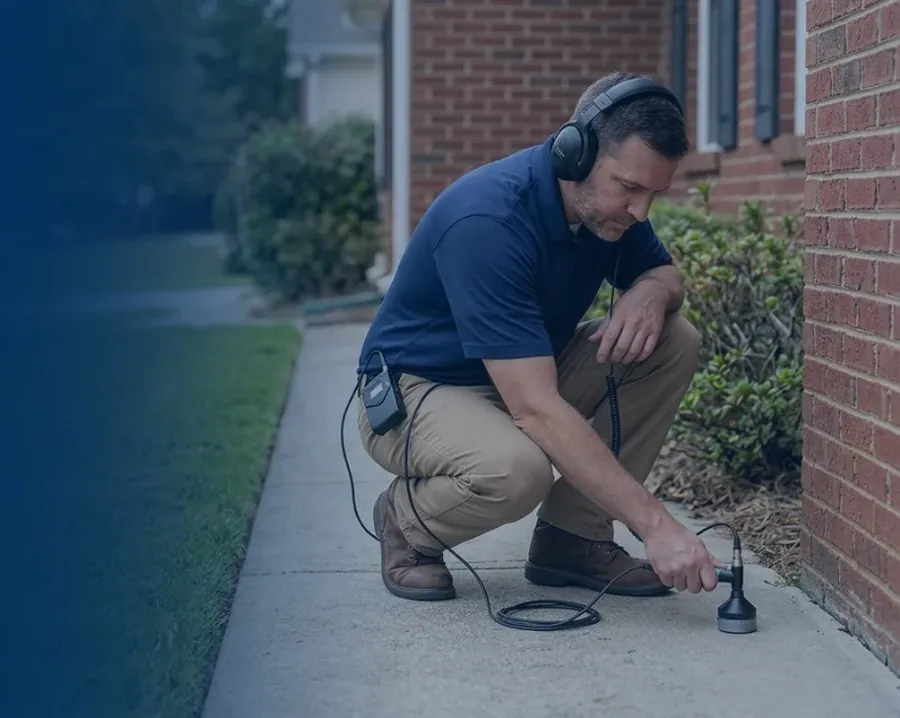
Acoustic listening, thermal imaging, pressure testing and tracer gas narrow it to a few inches first, so only that area has to be touched.
What to look for when you go down
- Standing water or wet soil, and whether it is under plumbing or under an exterior wall. Position tells you a lot before you touch anything.
- Mineral crust or green corrosion on copper, which is an active weep evaporating as fast as it leaks.
- Sagging or fallen insulation. It falls because it got wet.
- Rusted or dark ductwork, which usually means condensation rather than plumbing.
- The vapor barrier. Water sitting on it is coming from above; water under it is coming from the ground.
- Pipe material at the water heater or the main run. Gray plastic stamped PB2110 is polybutylene.
Do not go down if there is standing water near electrics, if you smell gas, or if you cannot get out easily. None of this is worth an injury, and a torch through the access hatch answers most of the questions anyway.
When the crawlspace is dry and the meter still moves
Then the leak is not under the house. The usual answer is the buried service line between the meter and the house, or irrigation teeing off it. Close the main house valve: if the meter still turns with the house isolated, the loss is outside, before it ever reaches the crawlspace.
Where these figures come from
Everything above is taken from a published source. Rates, policies and conditions change, so check the date on each before relying on it.
- US EPA, A Brief Guide to Mold, Moisture and Your Home: moisture control principles applicable to crawlspaces.
- Cobb County Water System, Water Leaks: meter test guidance.
Frequently asked questions
Is water in my crawlspace always a leak?
No. Groundwater after rain, poor surface drainage and summer condensation all put water under a Marietta house. The distinguishing test is the meter: if it turns with everything off, there is a pressurized leak. If it is still, look at drainage and humidity first.
How do I know if a crawlspace leak is a supply or drain line?
Timing. A supply line is pressurized constantly, so it leaks day and night whether or not anyone is home. A drain line only leaks while water is flowing through it, so the wet patch appears after a shower, a bath or a washing machine cycle.
Should crawlspace vents be closed in winter in Georgia?
Before a hard freeze, yes. Open vents move freezing air directly across uninsulated pipe, which is why crawlspace runs are the most common freeze failure in Marietta houses. Insulating the pipe matters more than insulating the ground.
Do crawlspace homes get slab leaks?
Not under the main living area, because there is no slab there. But many Marietta houses are mixed: a crawlspace over the original structure with a slab under a later addition, a garage or a sunroom. Leaks in those sections behave like slab leaks and are located acoustically.