
Last reviewed and updated: 2026-09-28
Georgia's year-round schedule allows landscape watering only before 10 a.m. and after 4 p.m. A leak in an irrigation lateral runs inside that window, underground, usually before dawn, so nobody sees it. The EPA puts a drip system leaking at one gallon per minute at $5,700 a year, and at Cobb's top-tier rates a 5 gal/min lateral is far more than that.
What the watering rules actually say
Under Georgia's Water Stewardship Act of 2010, outdoor landscape watering is permitted only before 10 a.m. and after 4 p.m., year-round. That is not a drought measure, it is the standing schedule, designed to cut evaporation during the hottest part of the day.
On 27 April 2026 the Georgia Environmental Protection Division declared a statewide Drought Response Level 1. Level 1 requires water systems to run public information campaigns; it does not add restrictions beyond the schedule already in force.
Cobb County notes that outdoor water use between 4 p.m. and 10 a.m. remains allowable and unaffected by a Level 1 response.
What 2026 actually did to the ground here
Conditions have improved. As of 21 September 2026, the US Drought Monitor shows none of Cobb County in any drought category. But the year as a whole was dry:
- January to August 2026 precipitation ran 5.42 inches below normal
- That is the 31st driest year to date in 132 years of record
- August alone was the 40th driest August on record
Two consequences matter for leaks, and neither is about the lawn:
- Systems ran harder and longer all summer, inside a compressed window, which means more hours of pressure on buried lateral pipe and more cycles through valves that were already worn.
- Georgia red clay shrinks as it dries and swells as it rewets. A five-inch deficit followed by recovery is a season of ground movement working against buried service lines, sewer laterals and anything cast into a slab. This is a real mechanism, not weather decoration.
Why irrigation leaks hide so well
Every other leak has a witness. This one does not.
| Factor | Effect |
|---|---|
| The pipe is buried | Nothing visible indoors, ever |
| It runs on a timer | Usually before dawn, when nobody is watching |
| It is on the house side of the meter | Every gallon is billed to you |
| Wet ground looks like watering | The symptom is indistinguishable from the system working |
| Zones are independent | One failed zone out of eight is easy to overlook |
The seasonal signature. A bill that climbs every spring and settles every autumn is almost never a plumbing failure inside the house. It is irrigation, either a genuine leak or a controller running far longer than anyone realizes.
Want the leak found before anything is opened?
Acoustic listening, thermal imaging, pressure testing and tracer gas narrow it to a few inches first, so only that area has to be touched.
Proving it in fifteen minutes
- Turn the controller fully off. Not a rain delay. Off, so no zone can fire during the test.
- Close the main house shut-off valve but leave the irrigation supply open.
- Watch the meter's low-flow indicator. If it is still turning with the house isolated and the controller off, the loss is in the irrigation system.
- Close the irrigation supply too and re-check. If it stops now, that confirms it. If it keeps moving, you are looking at the buried service line instead.
What actually fails
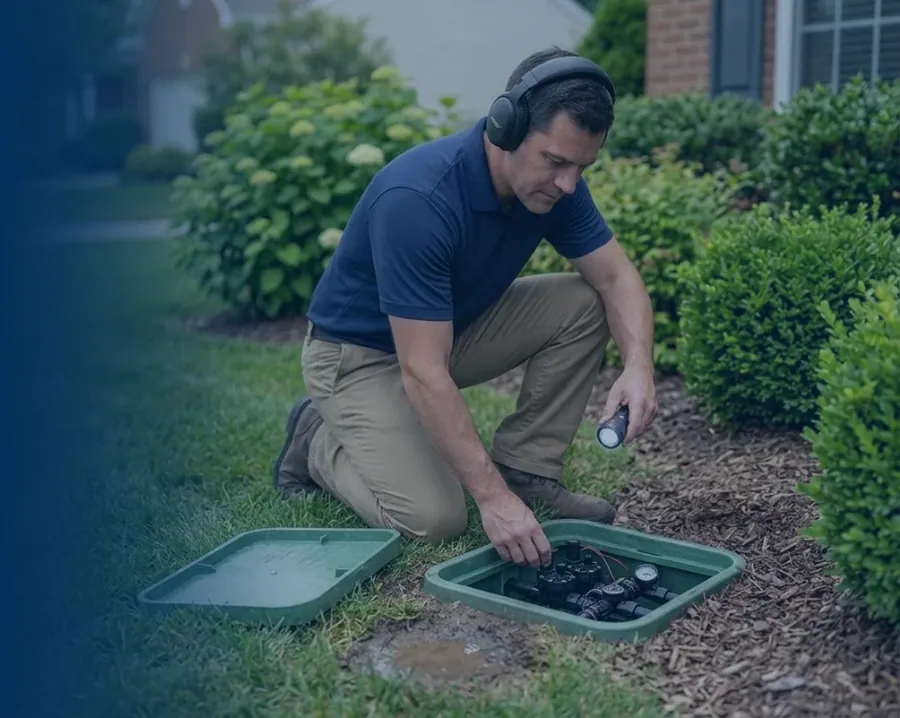
- A valve that will not seat. Debris or a worn diaphragm holds it partly open and that zone runs continuously, whatever the controller says.
- A cracked lateral. Usually from ground movement or a shovel, and it only leaks while that zone is pressurized.
- A broken head or a missing nozzle. The most visible failure and the least expensive.
- The backflow preventer or the tee off the service line. Leaks here run all the time, not just during a cycle, which makes them the costliest of the group.
Locating a buried lateral is done by pressurizing zones independently and listening, which is irrigation leak detection work rather than guesswork with a shovel.
Keep the parts receipt. Cobb County accepts a parts receipt as proof of repair for a leak credit, which matters because irrigation repairs are often done by the homeowner or a landscaper rather than a licensed plumber.
Where these figures come from
Everything above is taken from a published source. Rates, policies and conditions change, so check the date on each before relying on it.
- Georgia Environmental Protection Division, Drought Response Level 1 declaration, 27 April 2026.
- Cobb County Water System, Water Conservation and Drought: watering permitted before 10 a.m. and after 4 p.m.; Level 1 adds no further restriction.
- US Drought Monitor via Drought.gov, Cobb County conditions, 21 September 2026: 0% of the county in D0-D4; Jan-Aug precipitation 5.42 in below normal; 31st driest year to date in 132 years.
- US EPA WaterSense, Know Your Flow, 2026: a drip irrigation leak at 1 gallon per minute can waste $5,700 per year.
Frequently asked questions
What are the watering restrictions in Cobb County?
Landscape watering is allowed only before 10 a.m. and after 4 p.m., year-round, under Georgia's Water Stewardship Act of 2010. A statewide Drought Response Level 1 was declared on 27 April 2026, which adds public information duties rather than further restrictions.
Is Cobb County still in a drought in September 2026?
No. As of 21 September 2026 the US Drought Monitor shows none of Cobb County in any drought category. The year has still been dry overall, with January to August precipitation running 5.42 inches below normal.
How do I know if my sprinkler system is leaking?
Turn the controller fully off, close the main house valve but leave the irrigation supply open, and watch the water meter's low-flow indicator. Movement with the house isolated and the controller off puts the loss in the irrigation system.
Can I get a leak credit for an irrigation leak?
Yes, an irrigation lateral or a stuck valve is normally an eligible plumbing failure in Cobb County, with proof of repair. Keep the parts receipt, because irrigation work is often done without a plumber's invoice.