
Last reviewed and updated: 2026-09-28
The EPA states that if wet materials are dried within 24 to 48 hours of a leak, in most cases mold will not grow. That window is why a burst pipe caught immediately is often a drying job, while a hidden leak that ran for weeks behind a wall is a remediation job. The EPA is equally clear that cleaning mold without fixing the water problem means it comes back.
The window, in the EPA's own words
From A Brief Guide to Mold, Moisture and Your Home:
- "If wet or damp materials or areas are dried 24-48 hours after a leak or spill happens, in most cases mold will not grow."
- "It is important to dry water-damaged areas and items within 24-48 hours to prevent mold growth."
- "If you clean up the mold, but don't fix the water problem, then, most likely, the mold problem will come back."
- Keep indoor humidity "below 60 percent (ideally between 30 and 50 percent) relative humidity."
The EPA's summary of the whole subject is one sentence: "The key to mold control is moisture control."
Why a hidden leak is the harder case
A burst pipe announces itself. You know the hour it started, the drying begins that day, and the 24 to 48 hour window is realistic.
A concealed leak does the opposite. A weeping fitting inside a wall, a slab leak under flooring, or a supply line above a ceiling can run for weeks before anything is visible, because water travels along framing and appears somewhere other than its source. By the time there is a stain to see, the window closed a long time ago.
| Signal | What it suggests about timing |
|---|---|
| A visible stain on a ceiling or wall | The leak has been running long enough to saturate and travel |
| A musty smell in one room, nothing visible | Moisture present for weeks; growth has started somewhere unseen |
| Cupping hardwood or lifting laminate | Sustained moisture from below, usually weeks to months |
| Damp with no source above it | Water arriving from underneath or traveling along framing |
| Bill climbing for several months | Continuous loss; whatever it is, it is not recent |
Want the leak found before anything is opened?
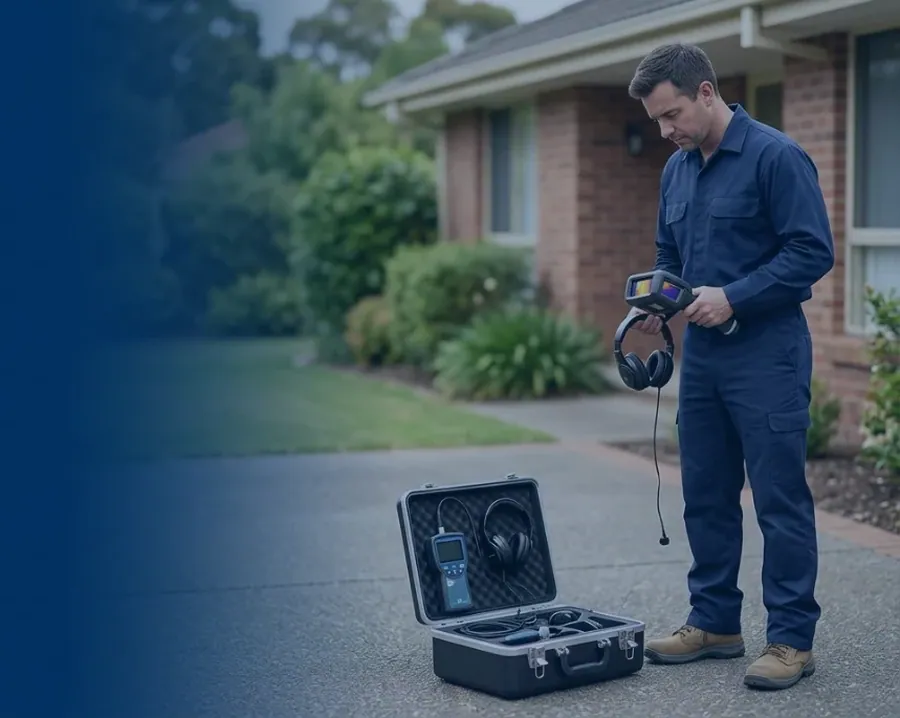
Acoustic listening, thermal imaging, pressure testing and tracer gas narrow it to a few inches first, so only that area has to be touched.
The order that actually works
- Find the water first. Remediation before the source is fixed is money spent on a problem that returns. Locating is what thermal imaging and moisture mapping are for, and they also show how far the moisture actually spread, which is usually further than the stain.
- Stop it. Close the main shut-off if the loss is active.
- Document before you clean. Photograph the damage, the moisture readings and the opened area. Evidence cannot be recreated once a wall is closed up or carpet is lifted.
- Dry, then repair, then remediate what is left. In that order.
Where the timing hits your insurance claim
This is the practical reason the window matters beyond the health question. Georgia homeowners policies commonly cover damage that is sudden and accidental, and commonly exclude damage from gradual deterioration, wear and tear, or long-term seepage. Many also limit or exclude mold specifically, or cap it at a small sublimit.
A slow hidden leak sits precisely on the wrong side of that line, and an adjuster's argument will be that the loss was gradual. What helps:
- A dated leak detection report stating what failed and when it was found
- Photographs from before the cleanup
- Evidence you acted promptly once you knew, which is what distinguishes an unnoticed leak from a neglected one
The insurance page covers what policies here typically do and do not pay for.
On health, briefly and honestly. We locate leaks; we are not industrial hygienists and this is not medical advice. The EPA's position is that mold should be cleaned up promptly and the moisture source fixed, and that people with asthma or allergies may be more affected. If anyone in the house is unwell, that is a conversation for a doctor and a qualified remediation contractor, not a plumbing website.
Where these figures come from
Everything above is taken from a published source. Rates, policies and conditions change, so check the date on each before relying on it.
- US EPA, A Brief Guide to Mold, Moisture and Your Home: 24-48 hour drying window, indoor humidity below 60% (ideally 30-50%), and the requirement to fix the water problem as well as clean the mold.
- General Georgia homeowners policy structure regarding sudden and accidental loss versus gradual deterioration; confirm terms with your own carrier.
Frequently asked questions
How fast does mold grow after a water leak?
The EPA states that if wet materials are dried within 24 to 48 hours of a leak, in most cases mold will not grow. Beyond that window growth becomes likely, which is why a hidden leak that ran for weeks is treated differently from a burst pipe caught the same day.
Does homeowners insurance cover mold from a leak in Georgia?
It depends on the policy and on how the loss is characterized. Policies commonly cover sudden and accidental damage and exclude gradual deterioration, and many limit mold specifically. A dated leak detection report and photographs taken before cleanup are what support the claim.
Should I remediate the mold or fix the leak first?
Fix the water first. The EPA is explicit that cleaning mold without fixing the water problem means it most likely comes back. Locating the leak also establishes how far the moisture actually spread, which is usually beyond what is visible.
What humidity level prevents mold indoors?
The EPA recommends keeping indoor relative humidity below 60 percent, and ideally between 30 and 50 percent. In a Georgia summer that usually means addressing the moisture source as well as running air conditioning or a dehumidifier.